



The shifting priorities
of Enterprise IT — and the new category to support it
From Building Infrastructure to leveraging Cloud Service Providers
Enterprise IT teams used to spend the majority of their time building and running data centers. Then the cloud changed everything. Azure, AWS, and Google eliminated the need to own infrastructure. Smart organizations outsourced it — and never looked back.
IT is looking to reduce its time spent here to 15–20% of capacity, with a focus on performance monitoring, capacity planning, and cost. This is the domain of IT Operations Management (ITOM).
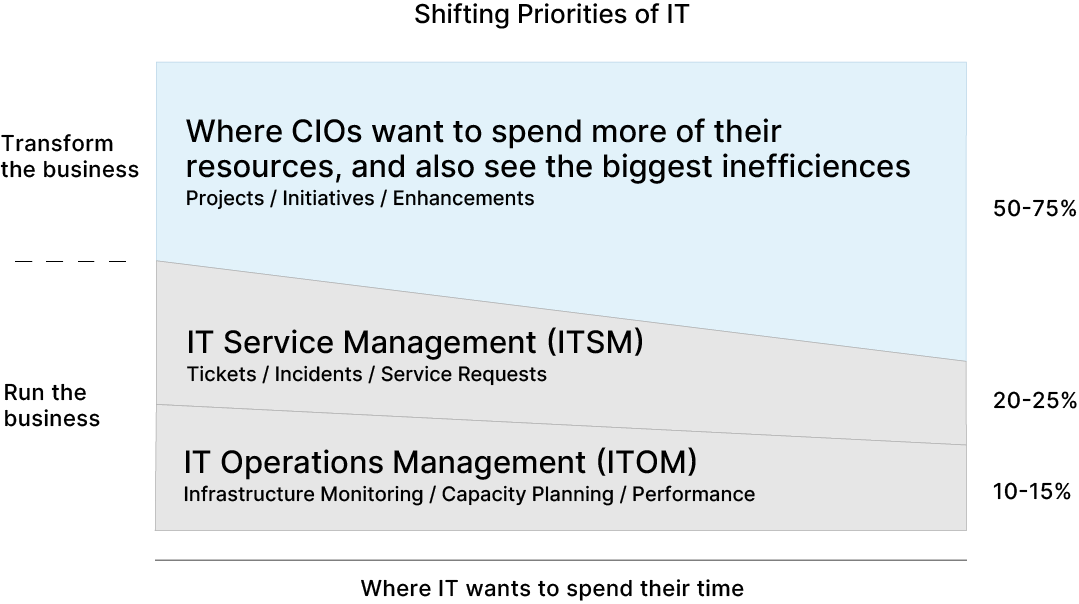
Managing the Explosion of Enterprise Cloud Applications and Becoming a Service Bureau to the Business
As enterprises migrated workloads from on-premises to the cloud, IT teams embraced SaaS at scale — procuring and implementing cloud-first solutions across every business function. Alongside this, platforms such as IT Service Management (ITSM) have become the operational backbone for delivering the employee experience and internal services, handling tickets, incidents, service requests, password resets, and device provisioning. IT is looking to reduce its Service Management capacity spend down to 10–15%.
These first two shifts made IT more efficient. Neither made it transformational.
IT Operations Management (ITOM) and IT Service Management (ITSM) helped IT teams run more effectively and better serve the business. But they didn't accelerate IT's ability to drive business change — to understand and transform the mission-critical systems that actually run the enterprise.
That has always been the CIO's greatest opportunity. And their greatest source of inefficiency.
AI is about to change that entirely.
Business Transformation Will Stop Waiting on Enterprise IT and Start Leading with It.
Instead of transformation sitting in a backlog, IT leads it — proactively, with speed and intelligence that simply wasn't possible before. Forward-looking IT teams are targeting 50–70% of their capacity here. Not because they have to. Because this is where the impact is.